Can a Receptionist Accept Service of Process in California?
A receptionist may sometimes receive legal papers in California, but the title on the desk does not decide whether service is valid. The answer depends on who is being served, the method used, the address, the receptionist’s actual role, and what the process server does after leaving the papers.
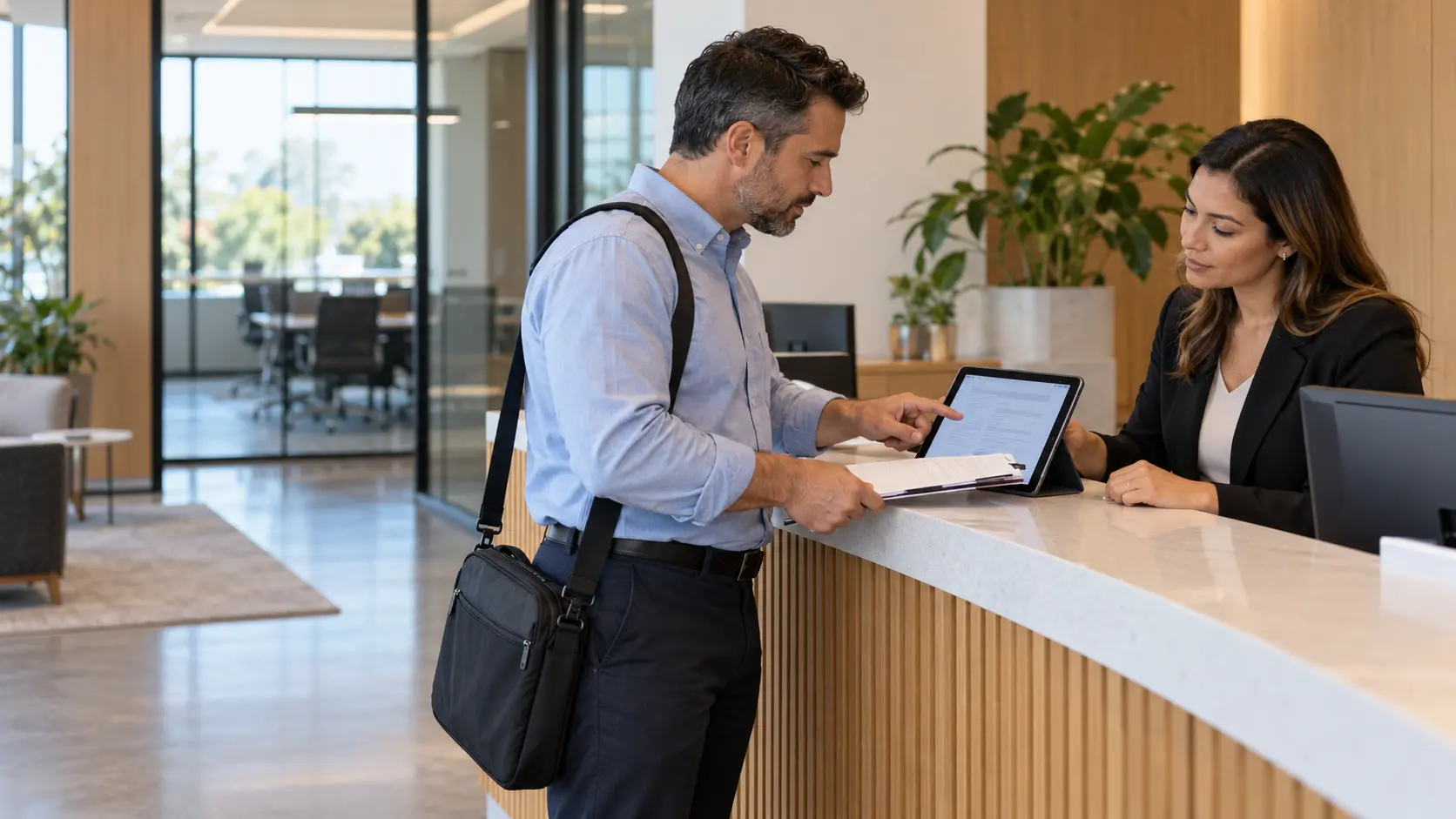
A process server enters an office and asks for the person or company named in the assignment. The receptionist says the executive is unavailable, the registered agent is not in, or the employee no longer comes to that location. The receptionist may offer to take the papers, refuse them, call a manager, or say that all legal documents must go to a corporate office in another city.
At that moment, the field server has to make a decision that is more complicated than it appears.
Can the papers be left at the reception desk? Would that be personal service on an authorized representative? Would it be substituted service on a person apparently in charge? Is a mailing required? Is this even the correct office of the party being served? Does the receptionist work for the defendant, the building, a coworking company, or an unrelated tenant?
The word receptionist does not answer any of those questions by itself.
California law identifies particular people and methods through which a summons may be served. A receptionist may fit one of those methods in a specific situation, but merely sitting at a front desk does not automatically create authority to accept service for every person or business using the address.
Key Takeaway
A California receptionist may receive papers when the receptionist is actually authorized to accept service or when the facts support substituted service on a person apparently in charge at the correct office or usual place of business. Personal service and substituted service are different methods. Substituted service generally requires a later first-class mailing to the same place, accurate documentation, and satisfaction of any applicable diligence requirement. A server should verify the party, address, receptionist’s role, and service method before treating the assignment as complete.
The First Question Is Not “Can the Receptionist Take It?”
The first question is: Who is the party to be served?
A reception desk may be involved in service on several very different targets:
- an individual employee at that person’s workplace;
- a California corporation;
- a foreign corporation registered in California;
- a limited liability company;
- a partnership or other unincorporated association;
- an individual registered agent for a business entity;
- a corporate registered agent with a professional service office;
- a government agency or public entity;
- a business operating under a fictitious business name.
Each target can involve a different statutory route. A receptionist who may be a proper substituted recipient for an employee is not necessarily a person authorized to receive personal service for the employer. A person working at the lobby desk of a shared building is not necessarily connected to any tenant. An employee of a professional registered-agent company may be authorized through that company’s filing and internal procedures, while a generic building concierge may have no comparable role.
The process server therefore needs to identify both the named party and the legal capacity in which the papers are being delivered.
Personal Service and Substituted Service Are Not the Same
Most reception-desk mistakes begin when these two methods are treated as interchangeable.
Personal Service Through an Authorized Person
For a corporation, California Code of Civil Procedure section 416.10 permits delivery to specified people. The list includes the designated agent for service of process, certain corporate officers, a general manager, and a person authorized by the corporation to receive service of process.
If a receptionist is genuinely authorized by the corporation to receive service, delivery may be documented as personal delivery to an authorized person on behalf of the corporation. The authority is the important fact. The job title is secondary.
A receptionist who says, “I am authorized to accept service for this company,” may provide evidence relevant to that conclusion. A receptionist who says, “I can take packages,” has said something different. Authority to receive mail, deliveries, visitors, or internal documents does not automatically establish authority to accept service of process.
The server should not convert convenience into legal authority.
Substituted Service at an Office
California Code of Civil Procedure section 415.20 provides procedures for substituted service in specified situations. The statute allows papers to be left with a person apparently in charge at the office, usual place of business, or qualifying usual mailing address, depending on the party and subdivision involved. The papers must then be mailed as required by the statute.
Under this route, the receptionist does not need to be the corporation’s registered agent or personally authorized to accept service. Instead, the question is whether the receptionist is an appropriate person apparently in charge at the correct place under the applicable subdivision.
This is a different legal theory and must be reported differently.
The broader eligibility rules are discussed in our guide to who can receive papers during substituted service.
When a Receptionist May Be an Authorized Recipient
A receptionist can be more than a person answering phones. In some offices, the front-desk employee is specifically trained and authorized to accept legal process. This is common in professional registered-agent offices, legal departments, larger corporate headquarters, and organizations with a centralized legal-intake procedure.
Facts that may support actual authority include:
- the receptionist expressly states that they are authorized to accept service for the named entity;
- the office identifies the receptionist as a legal-process intake employee;
- the entity’s registered agent is a corporation and the receptionist is one of the people designated through the applicable filing or office procedure;
- a legal department or corporate representative confirms the receptionist’s authority;
- the receptionist follows an established intake process for service documents;
- the server has reliable assignment information identifying that person as an authorized recipient.
Even then, the server should confirm that the authority applies to the exact entity named in the documents. A corporate services office may represent hundreds of entities. A receptionist authorized for one affiliate is not automatically authorized for every company using a similar name.
The server should record the receptionist’s name, title, statement of authority, employer, office location, and the entity for which the papers were accepted.
When a Receptionist May Be a Person Apparently in Charge
The phrase “person apparently in charge” focuses on the circumstances observed at the office. It does not require the recipient to be the company’s highest-ranking employee. It also does not mean that every adult near a reception desk qualifies.
A receptionist may appear to be in charge when the person:
- controls access to the office or employee work area;
- checks visitors in and contacts personnel inside the business;
- receives business deliveries for the office;
- states that they are responsible for the office while the target is unavailable;
- works directly for the named business at its operational office;
- is the only responsible staff member present during usual office hours;
- consults a supervisor and is directed to receive the papers;
- handles legal documents through the office’s normal intake procedure.
No single fact is always decisive. The analysis should consider the entire setting, including the identity of the employer, the relationship to the target, the physical office, the receptionist’s responsibilities, and the statements made during the interaction.
A strong field note does not merely say “left with receptionist.” It explains why the person appeared to be in charge at that particular office.
When the Front Desk Is Not the Defendant’s Office
Modern commercial addresses create difficult reception scenarios. The street address may lead to a lobby serving an entire building rather than the defendant’s actual office.
Building Lobby Receptionist
A lobby receptionist may work for the property manager or a security contractor. That person may control elevators and visitor access but have no employment relationship with the company being served.
Access control alone does not necessarily make the person apparently in charge of a tenant’s office. The server should identify who employs the receptionist and whether the receptionist receives items for the tenant. If the receptionist only operates the building desk, leaving papers there can create a serious location and capacity problem.
Shared Office or Coworking Receptionist
A coworking facility may provide mail handling and front-desk services to dozens of businesses. Some members have permanent offices. Others use the address only for mail or occasional meetings.
The server should determine:
- whether the named business is a current member;
- whether it maintains an actual office there;
- whether employees regularly work at the location;
- whether the front desk is authorized to receive legal process;
- whether the location is only a mail service or virtual office;
- whether the target has a specific suite, office, or mailbox;
- whether the receptionist works for the facility or the target.
A shared receptionist may be an appropriate recipient in a specific case, but the shared-office model makes assumptions particularly dangerous.
Security Desk
A security officer may prevent access to the target’s suite. That does not automatically make security an authorized recipient or a person apparently in charge of the target’s office.
The field report should distinguish between a security employee who merely denied entry and a desk that routinely receives documents on behalf of building tenants. The report should also record whether the target’s actual office could be reached, whether tenant staff were contacted, and whether another entrance or reception area existed.
Virtual Office or Mail Center
A virtual office may provide an address without providing an ordinary place of business. A commercial mail receiving agency can also implicate special statutory provisions. The server should not describe the location as a staffed company office unless the observed facts support that statement.
If the address is only a mail-receiving location, the assignment may require review under the provisions applicable to a usual mailing address or commercial mail receiving agency rather than ordinary office service.
Serving an Individual Employee Through a Workplace Receptionist
Suppose the named defendant is an individual who works for the business. The receptionist is not being asked to accept service for the employer. The receptionist is being considered as a substituted recipient for the individual at the individual’s usual place of business.
Under Code of Civil Procedure section 415.20(b), substituted service on specified individuals generally requires that personal delivery could not be completed with reasonable diligence. The server may then leave the papers at the person’s usual place of business in the presence of a person apparently in charge who is at least 18 years old, inform that person of the contents, and complete the required mailing.
This situation raises several field questions:
- Does the individual currently work there?
- Is the location the individual’s usual place of business?
- Is the receptionist employed by that business or an unrelated building operator?
- Is the receptionist at least 18 years old?
- Does the receptionist appear responsible for the office?
- Were reasonable personal-delivery efforts completed when required?
- Was the receptionist informed of the general nature of the papers?
- Will copies be mailed to the same place where they were left?
A receptionist’s statement that the employee “is not here today” supports a different conclusion from a statement that the employee “has not worked here for six months.” In the second situation, the server should not simply leave the papers and hope the old address remains legally useful.
Serving a Corporation Through a Receptionist
When the party is a corporation, the server should begin with the corporation’s correct legal name and the person identified for service. California Code of Civil Procedure section 416.10 lists multiple people through whom a corporation may be served, including the designated agent for service, named officers, a general manager, and a person authorized by the corporation to receive service.
The receptionist may fit into the assignment in two principal ways:
- Authorized recipient: The receptionist is actually authorized to accept service for the corporation, supporting delivery under the applicable personal-service route.
- Substituted recipient: The receptionist is the person apparently in charge at the proper office under section 415.20(a), and the required mailing is completed afterward.
Those two outcomes should not be blended on the Proof of Service.
If the receptionist only says that the registered agent is unavailable, that statement does not by itself establish the receptionist’s authority for personal service. It may, however, be relevant to a substituted-service evaluation if the location and other facts satisfy the statute.
For the complete entity framework, review our guide on how to serve a corporation or LLC in California.
Serving an LLC Through a Receptionist
California limited liability companies must designate an agent for service of process. California Corporations Code section 17701.16 provides procedures for serving an LLC or foreign LLC and addresses service on an individual agent, a corporate agent, and court-authorized service through the Secretary of State when the statutory conditions are satisfied.
The process server should confirm whether the listed agent is:
- an individual person;
- a corporation registered to act as an agent;
- another authorized business organization;
- located at the same address as the LLC;
- located at a professional registered-agent office.
A receptionist at the LLC’s operating office is not necessarily the designated agent. A receptionist at a professional agent’s office may work within a formal service-intake system, but the server still needs to confirm the exact entity and the employee’s role.
Because entity type affects the statutory analysis, a server should not use the corporation checklist for every business name that ends in “LLC.” The field result should return to operations for review whenever the named agent, entity record, or recipient capacity is unclear.
The Mailing Step Is Not Optional
Leaving papers with a qualifying receptionist does not complete substituted service by itself.
Under section 415.20, the required copies must be mailed by first-class mail, postage prepaid, to the person or entity being served at the place where the papers were left. Service under the statute is generally deemed complete on the tenth day after the mailing.
Operational mistakes occur when:
- the field server marks the case complete immediately after leaving the papers;
- nobody is assigned responsibility for the mailing;
- the mailing goes to a different address without legal review;
- the mailing date is entered incorrectly;
- the packet mailed does not match the packet left at the office;
- the Proof of Service is signed before the mailing occurs;
- the office cannot identify who performed the mailing;
- the mailing event is missing from the final proof.
Our detailed guide to the mailing step after substituted service explains how field delivery, mailing, completion date, and proof preparation should remain connected.
What a Process Server Should Ask at the Reception Desk
The server should be professional, concise, and focused on facts. The goal is not to interrogate the receptionist. It is to determine the correct recipient, location, and method.
Useful questions may include:
- “Does [full legal name] maintain an office here?”
- “Are you employed by [named company] or by the building?”
- “Is [named individual] currently employed at this location?”
- “Is the registered agent or legal department available?”
- “Are you authorized to accept service of process for [exact entity name]?”
- “What is your name and job title?”
- “Who is responsible for the office while the named person is unavailable?”
- “Does this office accept legal documents for that entity?”
The precise questions should fit the assignment and should not disclose unnecessary information. The server should identify the general nature of the documents when the applicable method requires it, but should avoid discussing allegations or case details with unrelated people.
What the Field Note Should Record
A defensible reception-desk report should let another professional understand the interaction without calling the server days later.
The note should generally include:
- the date and exact time;
- the full address, suite, floor, and business signage;
- the name of the business occupying the office;
- the identity of the party being served;
- the name and title given by the receptionist;
- who employed the receptionist;
- whether the receptionist stated they were authorized to accept service;
- facts showing why the receptionist appeared to be in charge, if substituted service was used;
- whether the registered agent, officer, manager, or employee was requested;
- what the receptionist said about the target’s presence or relationship to the address;
- whether the receptionist accepted, refused, or directed the server elsewhere;
- whether the general nature of the papers was explained;
- the exact documents left;
- the required mailing status;
- any access limitation or safety concern.
If the receptionist refuses to provide a name, the server should not invent one. The server can record an objective description, stated role, location behind the reception desk, employer if known, and the exact refusal.
Weak Report Versus Useful Report
Weak Report
Served receptionist at office.
This note does not identify the receptionist, explain the method, confirm the employer, establish that the location was the correct office, show authority, or document the mailing.
Useful Report
On October 29, 2026, at 10:18 AM, I entered Suite 420 at 600 Harbor Plaza, San Diego, California. The suite directory and reception wall displayed the name Harbor Analytics, Inc., matching the entity named in the assignment. I asked for the company’s registered agent, Maria Lopez. The front-desk employee, who identified herself as Dana Reed, Office Coordinator, stated that Ms. Lopez was not in the office and that Dana was responsible for receiving office deliveries while she was away. Dana confirmed that she was employed by Harbor Analytics, Inc., not the building. She did not state that she was personally authorized to accept service for the corporation. Following the approved substituted-service instruction, I left the listed summons and complaint with Dana, informed her of the general nature of the papers, and immediately reported the delivery for completion of the required first-class mailing to Harbor Analytics, Inc. at the same Suite 420 address.
The useful report does not claim personal service on an authorized agent. It identifies facts supporting the method actually used and preserves the information needed for the mailing and Proof of Service.
Common Receptionist Service Mistakes
1. Assuming Every Receptionist Is Authorized
A front-desk title does not establish authority to accept service. The server should identify the legal route and record the facts supporting it.
2. Calling Substituted Service “Personal Service”
If the papers were left with a person apparently in charge rather than delivered to an authorized statutory recipient, the proof should not describe personal service merely because the receptionist physically accepted the packet.
3. Leaving Papers in a Shared Building Lobby
A building employee may have no relationship to the target. The server should locate the target’s office or establish why the lobby recipient is connected to that office.
4. Serving the Brand Instead of the Legal Entity
The sign on the wall may display a trade name while the lawsuit names a corporation or LLC with a different legal name. The server should match the assignment to the correct entity and address.
5. Ignoring the Receptionist’s Statement That the Target Moved
If reliable information shows that the person or entity no longer uses the office, the server should report the address concern. Leaving papers anyway can waste time and create a misleading record.
6. Failing to Inform the Recipient of the General Nature
When the applicable substituted-service provision requires the recipient to be informed of the contents or general nature, the field note should show that the server completed that step.
7. Forgetting the Mailing
This is one of the most serious operational failures. A physical handoff to the receptionist is only one component of substituted service.
8. Preparing the Proof From Memory
The recipient’s name, title, capacity, address, date, time, method, and mailing details should come from the contemporaneous case record. Our review of common Proof of Service mistakes explains how inconsistencies create avoidable work for law firms.
How POS-010 Should Reflect the Actual Event
California’s Proof of Service of Summons, form POS-010, separates personal service from substituted service.
For personal service on an entity, the proof may identify the party served and the person served on behalf of the entity or as an authorized agent. For substituted service, the form asks for the person with whom the papers were left, the applicable business, home, or mailing-address category, the mailing information, and a declaration of diligence when required.
The proof should not be selected according to which result looks cleaner. It should reflect the field event and the applicable law.
Before release or filing, the review should confirm:
- the exact legal party name;
- the correct service method;
- the receptionist’s name and title or objective description;
- the receptionist’s relationship to the office and party;
- the service address and suite;
- the date and time of delivery;
- the required mailing date and city;
- the documents served;
- any required declaration of diligence;
- the notice-to-person-served information for entity service;
- consistency between the proof and original field note.
The Notice to the Person Served Matters
California Code of Civil Procedure section 412.30 addresses the notice required on a summons served in an action against a corporation or unincorporated association. The notice identifies that the person is being served on behalf of the named organization and references the applicable statutory capacity.
This reinforces the need to distinguish the human recipient from the legal party. Dana Reed may physically receive the packet, while Harbor Analytics, Inc. is the party being served. The proof and the notice should preserve that distinction.
A server should review the summons and assignment before the visit. Discovering at the reception desk that the entity name or service-capacity information is incomplete is an intake problem that should have been identified earlier.
What Changes on January 1, 2027?
California’s AB 747 changes parts of the service and proof framework beginning January 1, 2027. Among other changes, the later-operative version of Code of Civil Procedure section 415.20 provides a more specific reasonable-diligence standard for certain substituted service under subdivision (b). Covered service or attempted service of summons will also involve new site-photo documentation requirements under section 417.10.
For an office attempt, this increases the importance of documenting the exact location. The record may need to show the door or entrance of the specific office or business, with the required automatically recorded date, time, and location information, subject to the statute’s details and exceptions.
A photo of a building lobby does not answer whether the server reached the defendant’s actual office. A photo of a reception desk does not establish the receptionist’s authority. Photographic evidence supports location and timing, but the field note still needs to explain identity, capacity, access, statements, and method.
Process serving companies should verify the final 2027 Judicial Council forms and instructions before using them. A workflow built around the older POS-010 should not be assumed to satisfy every new requirement after the operative date.
A Practical Receptionist Service Decision Framework
Before leaving papers at a reception desk, the process server or operations team should work through the following sequence.
- Identify the party. Is the target an individual, corporation, LLC, partnership, registered agent, or another legal person?
- Confirm the address. Is this the target’s actual office, usual place of business, registered-agent address, or only a shared lobby or mail service?
- Identify the receptionist’s employer. Does the person work for the target, a registered-agent company, the landlord, security, or a coworking provider?
- Determine the method. Is the person an authorized recipient for personal service, or is substituted service being considered?
- Check prerequisites. Has any required reasonable diligence been completed and documented?
- Confirm recipient facts. Is the person at least 18 when required, and what facts show that the person is apparently in charge?
- Explain the papers appropriately. Inform the recipient of the general nature when required without discussing unnecessary case allegations.
- Record the event immediately. Capture the name, title, statements, employer, suite, timing, access, and documents.
- Complete the mailing. If substituted service is used, make sure the statutory mailing is performed and documented.
- Review the proof. Confirm that POS-010 or the applicable proof matches the field record before signing or filing.
Why Law Firms Should Care About the Reception Desk
A reception handoff can look routine in a status update. It may become important later if the recipient, method, or address is challenged.
The law firm may need to know:
- why the receptionist was considered authorized or apparently in charge;
- whether the target actually maintained an office at the address;
- whether the server reached the correct suite;
- whether the receptionist worked for the defendant;
- what the receptionist said about the target;
- whether the statutory mailing occurred;
- when service was deemed complete;
- whether the Proof of Service accurately describes the interaction.
A provider that reports only “served receptionist” transfers the investigation back to the paralegal. A managed provider should preserve the facts, connect the mailing, review the proof, and flag uncertainty before the case is marked complete.
How Proofser Manages Reception-Desk Service
Proofser treats a reception-desk interaction as part of a complete assignment record, not as a one-line field result.
The case begins with review of the legal party, entity type, documents, address, registered-agent information, deadline, and client instructions. The field server receives the information needed to identify the correct office and recipient. After the visit, the report captures what the server observed, who was contacted, what the person stated, what method was used, and what must happen next.
If substituted service is appropriate, the mailing remains connected to the field delivery. If the receptionist’s role or the address is unclear, the case can be escalated for review rather than automatically converted into a completed service. The final Proof of Service can then be checked against the original field record.
This workflow protects the distinction between a receptionist who is authorized to accept service, a receptionist who may be a qualifying substituted recipient, and a lobby employee who has no reliable connection to the target.
Frequently Asked Questions
Can a receptionist accept service of process in California?
Sometimes. A receptionist may be an authorized person for personal service or may qualify as a person apparently in charge for substituted service at the correct office. The result depends on the party, statute, address, receptionist’s role, diligence requirements, and completion of any required mailing.
Is every receptionist authorized to accept legal papers?
No. A receptionist’s ordinary duties may include receiving visitors and deliveries without including authority to accept service of process. The process server should identify and document the actual basis for authority.
Can a process server leave papers with a receptionist for an employee?
California substituted service may permit papers to be left at an individual’s usual place of business with an adult person apparently in charge after the applicable reasonable-diligence requirement is satisfied. The recipient must be informed as required, and copies must be mailed to the same place.
Can a receptionist accept service for a corporation?
A receptionist may accept personal service if actually authorized to receive service for the corporation. A receptionist may also be a substituted recipient under Code of Civil Procedure section 415.20(a) when the facts and location satisfy that provision and the required mailing is completed.
Does a receptionist have to give their name?
A receptionist may refuse to provide a name. The server should not guess. The report can document the refusal, physical description, stated title, employer, location, and facts showing the person’s role at the office.
Can papers be left with a building security guard?
Not automatically. A guard employed by the building may not be authorized by or apparently in charge of the target’s office. The server should determine the guard’s relationship to the target, whether the actual office was accessible, and whether the guard routinely receives documents for that tenant.
What if the receptionist says the company moved?
The server should document the statement, the source, current signage, directory information, and other objective facts. The operations team should reassess the address before treating the location as valid or incurring repeated attempt fees.
Is mailing required after leaving papers with a receptionist?
If the delivery is substituted service under Code of Civil Procedure section 415.20, a first-class mailing to the person or entity at the place where the papers were left is part of the procedure. The physical handoff alone is not the entire service method.
Should the Proof of Service say personal or substituted service?
It should state the method that actually occurred. Delivery to an authorized statutory recipient may support personal service on the entity. Delivery to a person apparently in charge followed by mailing is substituted service. The field facts and applicable law should control the selection.
Does a photo prove that service on the receptionist was valid?
No. A photo may support the location and timing of an attempt, but it does not independently prove the receptionist’s authority, relationship to the target, or compliance with the selected service method.
Need a Business Service Assignment Reviewed?
Proofser coordinates California process serving with centralized intake, entity and address review, structured field reporting, required mailing tracking, Proof of Service quality control, and escalation when the recipient or service method is unclear.
Send the legal documents, exact party name, service address, known registered-agent information, deadline, and special instructions. Our operations team will review the assignment and coordinate the next step.
This article is for general informational purposes and is not legal advice. Service requirements depend on the documents, party type, recipient, case, address, applicable statute, court orders, operative date, and surrounding facts. Courts and responsible counsel determine the legal sufficiency of service.